
The Worst Village in England by Jean-Pierre Martinez
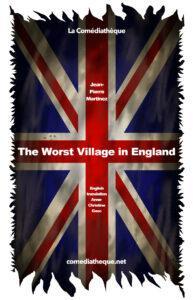
The Worst Village in England is a comedy by Jean-Pierre Martinez for 10 characters.
The last survivors of a dying village, forsaken by God and bypassed by the motorway, decide to take matters into their own hands and create an event that will drive traffic to their village. But it’s not easy to turn the worst village in England into the next must-see tourist attraction…
Original title in French : Le Pire village de France
English translation by Anne-Christine Gasc
Cast: 9 or 10 characters (males or females)
Download the playscript for free
Any performance requires prior authorization and the payment of performance rights.
A play written in May 2015
A play created in Plaine Haute – Saint Meen, the 30th of January 2016
Translations
espagnol : El pueblo más cutre de españa (translation by Jean-Pierre Martinez)
italiano : Il peggior paese d’Italia (translation by Jean-Pierre Martinez)
portuguese : A pior aldeia de Portugal (translation by Jean-Pierre Martinez)
The Worst Village in England, the song

Lyrics and music: Jean-Pierre Martinez
This song may be used, without obligation, as part of a stage production, upon simple request to the author and without any additional fees.
The audio file is available upon request, subject to prior authorization from the author for the use of the play’s text.
From Farce to Myth: Collective Deception as a Last Resort for Rebuilding Community
The Worst Village in England turns the threatened disappearance of a community into an exercise in collective fiction. Gradually deprived of their institutions and of any shared prospect for the future, the villagers invent an event capable of making them visible again. A fake death, a resurrection and a media miracle transform Jason, a marginal figure in the village, into a unifying hero. The lie therefore no longer serves merely to deceive: it becomes the last resort of a group that can find no reason to act together except through a story they all agree to share.
The large cast, the constant movement of characters across the stage and the freezer placed at the centre of the set give this transformation a distinctly collective and visual dimension. The farce exposes the villagers’ private interests, corruption and opportunism, yet their shared performance ultimately succeeds in creating a new myth. The village is neither reformed nor morally redeemed; nevertheless, it regains a name, a story and the possibility of a future. The satire of the society of spectacle thus becomes a reflection on the founding power of fiction: when reality is no longer enough to hold a community together, a story collectively accepted can still allow society to be rebuilt.
Book published by La Comédiathèque
ISBN 9782377052813/ Decembre 2019
76 pages ; 18 x 12 cm ; paperback.
Price: 12 €
Purchase the book